
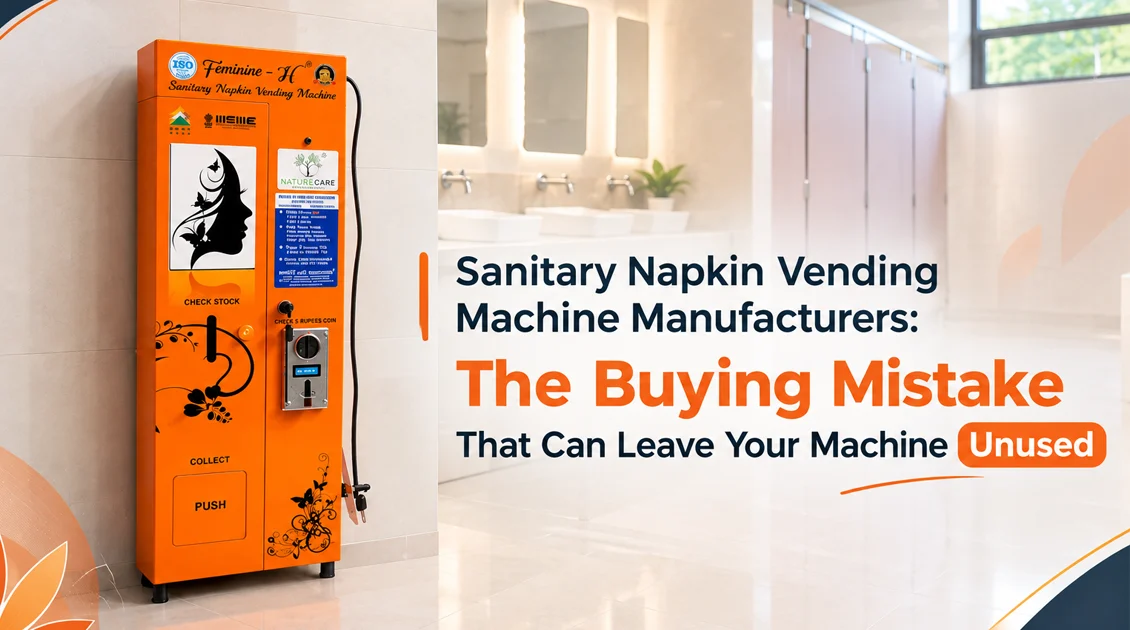
A sanitary napkin vending machine can look like a simple purchase. Choose a model, install it near a washroom, and make menstrual products available. But what happens when someone needs a pad and the machine is empty, difficult to operate, or incompatible with the products stocked inside?
That moment reveals whether the purchase has become a dependable service or merely an installed piece of equipment.
When comparing Sanitary Napkin Vending Machine Manufacturers, buyers need to consider everyday use, replenishment, accessibility, and maintenance alongside the machine itself.
This guide from Nature Care Solutions explains how to assess your requirements, ask useful questions, and plan an installation that people can rely on. Product specifications, prices, and service arrangements should be confirmed directly before ordering.
What Is a Sanitary Napkin Vending Machine?
A sanitary napkin vending machine is a dispenser designed to release individually packaged sanitary pads through a specified operating mechanism. Depending on the model, access may involve payment, a token, a manual control, or another release system.
Its purpose is to make products available without requiring someone to request them at a reception desk or administrative office.
However, the mechanism, capacity, power requirements, and compatible pad packaging vary. Buyers should request written specifications for the particular model under consideration rather than assuming all machines work alike.
Why Manufacturer Selection Matters
The purchase includes more than a cabinet and a dispensing mechanism. It also involves product compatibility, installation requirements, operating instructions, replacement parts, and support arrangements.
A machine that suits a small office may not suit a busy campus. Similarly, a model selected for one pad package may not reliably dispense another.
The manufacturer or supplier should help you understand these differences before purchase.
Your aim is straightforward: someone should be able to find the machine, understand its operation, and access a product when needed. Achieving that requires both suitable equipment and responsible day-to-day management.
Start with the User’s Experience
Before comparing models, think about the person using the machine.
They may need a pad unexpectedly, have limited time, or feel uncomfortable asking someone for assistance. Instructions should be easy to follow, and the location should allow reasonable privacy.
Consider whether users will have coins, tokens, or access to the payment method required by the chosen model.
Also review the physical placement. A machine mounted too high or behind an obstruction can be difficult to use. Discuss accessibility with your facilities team and confirm appropriate installation arrangements before purchase.
Where Can These Machines Be Considered?
Potential settings include schools, colleges, workplaces, healthcare facilities, residential institutions, and public facilities.
Each setting has different needs. A school may prioritise straightforward access and staff oversight. A workplace may want reliable availability across shifts. A public facility may need closer attention to replenishment, security, and responsibility for maintenance.
Do not assume the same operating model will suit every location.
Before approaching Sanitary Napkin Vending Machine Manufacturers, identify the intended users, access hours, installation space, and person responsible for managing the machine. These details make enquiries more productive.
1. Check Compatibility with Your Sanitary Pads
Ask which pad dimensions, packaging styles, and thicknesses the machine accepts.
Compatibility matters because individually packaged products can differ significantly. A mechanism designed around one format may not perform consistently with another.
Where possible, request a demonstration using the exact products you intend to stock.
Also ask whether different compatible products can be substituted later and whether adjustment is required. This can help you avoid unnecessary dependence on an unavailable product.
Obtain the compatibility details in writing, including any restrictions on loading orientation or package condition.
2. Choose a Suitable Dispensing Method
The operating mechanism should match how you want users to access products.
Ask whether the model uses manual operation, coins, tokens, electronic payment, or another method. Confirm exactly what is included; do not assume optional features are standard.
Consider the practical implications. Who supplies tokens? Who manages collections? What happens if the required payment method is unavailable?
If products will be provided without charge, ask about suitable access arrangements.
A demonstration should show the complete user journey, including what happens when a product fails to dispense.
3. Match Capacity to Your Refill Routine
A larger capacity is not automatically the better choice. The useful capacity is one that matches expected demand and your ability to replenish stock.
Estimate likely usage, then review how often staff can check the machine.
Ask for the capacity with your intended pad packaging, since the number of products may vary by size.
Find out how staff identify low stock and whether the model offers any stock indication. If no indicator is provided, establish a manual checking routine.
Availability depends on replenishment as much as storage capacity.
4. Confirm Power and Installation Requirements
Do not assume every vending machine requires electricity or that every model can operate without it.
Request the specific power requirements, mounting method, dimensions, and installation instructions.
Your facilities team should review the proposed location, wall or floor suitability, access for refilling, and any required electrical work.
Also ask who performs installation and what is included in the quoted price.
Before placing an order, clarify whether brackets, fittings, delivery, commissioning, and user training are included or charged separately. Written details help prevent misunderstandings during setup.
5. Examine Refill Access and Security
Refilling should be manageable for authorised staff.
Ask how the machine opens, how products are loaded, and whether tools are needed. Check who holds keys or access credentials and how replacements are obtained.
Security arrangements should protect stock and any collected payment without making routine management unnecessarily difficult.
During a demonstration, have the intended operator practise refilling.
This can reveal practical issues that are easy to miss when only viewing the machine from the outside. Clear operating instructions should support both dispensing and replenishment.
6. Ask About Maintenance and After-Sales Support
Before choosing between Sanitary Napkin Vending Machine Manufacturers, clarify what happens when something goes wrong.
Ask about warranty coverage, exclusions, service availability, replacement parts, and expected support procedures.
Useful questions include:
- How should a dispensing problem be reported?
- Can staff carry out basic checks?
- Which repairs require a technician?
- Are service visits charged separately?
- What documentation accompanies the machine?
Avoid relying on a broad promise of “complete support.” The arrangement should specify responsibilities and costs.
7. Compare the Full Cost of Ownership
The initial price is only part of the budget.
Consider delivery, installation, compatible pad supplies, replenishment time, applicable electricity costs, maintenance, and replacement parts.
If the model collects payment, include the administrative work involved. If products are provided free, plan a recurring stock budget.
Request a quotation that identifies the machine configuration and included services.
A lower purchase price may not represent better value if important expenses are excluded. Compare suppliers using the same requirements so that the figures are meaningful.
Planning an Enquiry with Nature Care Solutions
Before contacting Nature Care Solutions, prepare a short requirement brief.
Include the installation setting, number of locations, estimated usage, preferred access method, available space, and intended sanitary pad packaging.
Ask Nature Care Solutions to confirm the models available, technical specifications, compatibility, pricing, installation arrangements, warranty, and service coverage.
This guide does not establish a particular model’s features or availability. Those details should come from a current written quotation and supporting product documentation.
For multiple locations, discuss whether a demonstration or initial trial installation is possible before a larger order.
Make Replenishment Someone’s Responsibility
A machine without a named operator can quickly become unreliable.
Assign responsibility for stock checks, refilling, cleaning, and reporting faults. Decide who covers those tasks when the usual person is absent.
Keep a simple log of stock use and issues. Early records can help you adjust refill frequency and identify recurring problems.
Place an appropriate contact instruction nearby so users can report an empty machine or dispensing failure.
The operating plan should be ready before installation, rather than developed only after the first complaint.
Remember That Vending and Disposal Are Different
A vending machine provides access to sanitary pads. It does not automatically solve disposal requirements.
Review suitable waste collection arrangements separately with your facilities or waste-management team. Provide clear instructions and appropriate facilities according to applicable requirements.
Do not assume a vending machine includes a disposal unit or other related equipment unless the quotation explicitly states it.
Keeping these functions clear helps you plan a complete arrangement without confusing what each product is designed to do.
Frequently Asked Questions
How do I choose sanitary napkin vending machine manufacturers?
Compare product compatibility, dispensing method, capacity, installation requirements, warranty, service arrangements, and total cost. Request a demonstration and written specifications for the exact model.
Can every machine dispense every sanitary pad?
No. Compatibility depends on the machine and the pad’s dimensions and packaging. Confirm suitability using the products you intend to stock.
Do these machines always require electricity?
No universal answer applies. Power requirements depend on the operating mechanism and model. Ask for the manufacturer’s written specification.
Can a machine provide pads without payment?
That depends on its configuration. Confirm available access methods and whether a suitable free-access model or setting is offered.
How often should the machine be refilled?
Refill frequency depends on demand, capacity, and operating hours. Begin with regular checks and adjust the schedule using actual consumption records.
What should I ask Nature Care Solutions before ordering?
Ask about available models, pad compatibility, operation, capacity, installation, total price, warranty, spare parts, and service coverage. Confirm the agreed details in writing.
Choose Equipment You Can Keep Working
Comparing Sanitary Napkin Vending Machine Manufacturers is an opportunity to plan dependable product access, not simply purchase a dispenser.
Begin with your users, confirm compatibility, and establish who will manage stock and maintenance.
To enquire with Nature Care Solutions, share your site requirements and request a current quotation with clear specifications. A considered purchase should leave you with suitable equipment—and a practical plan to keep it available when needed.